
Legal expert tells NAACP panel that district has highest expulsion rate in Pa.
By Kyle Carrozza, Staff Writer, The Times
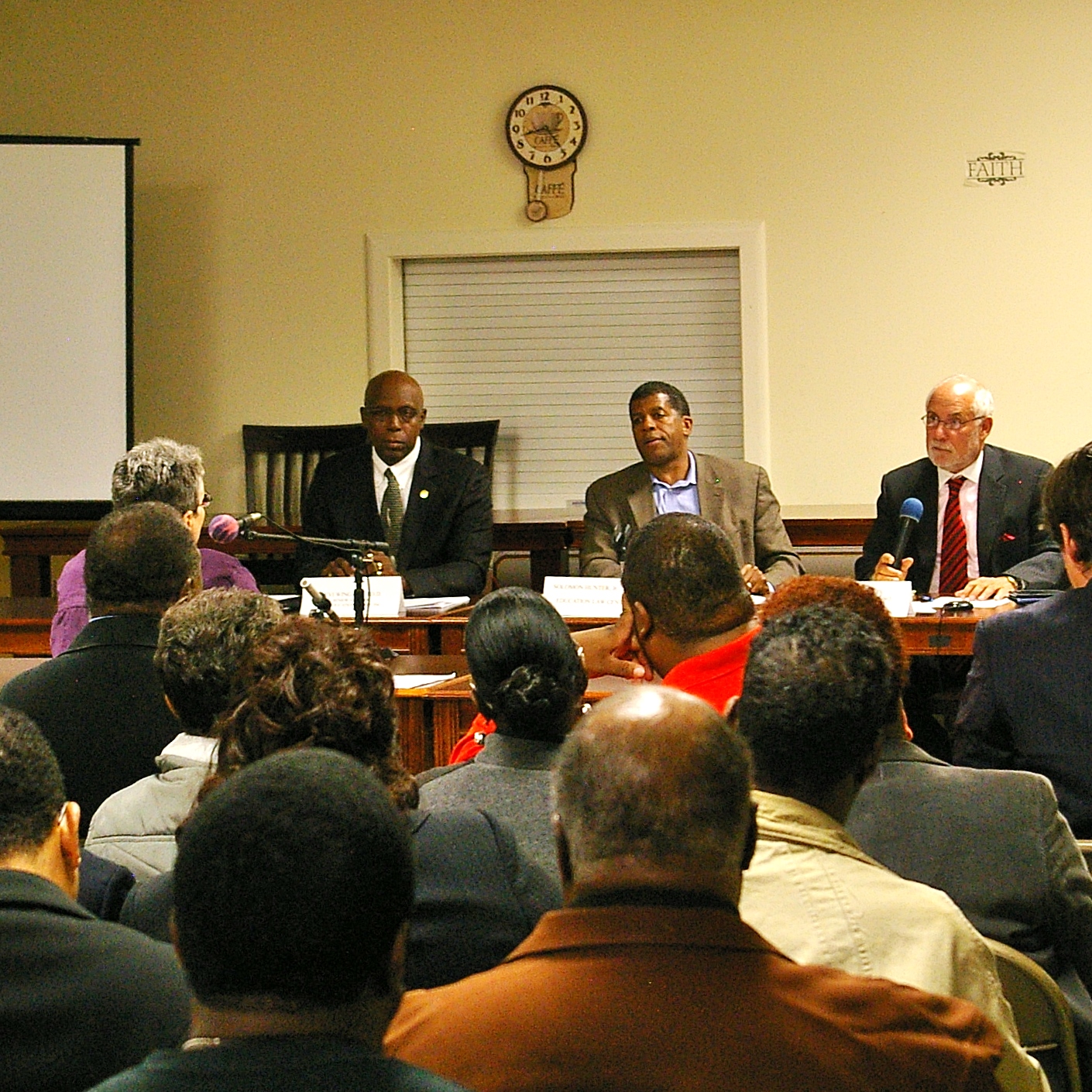
Connie Mohn, Director of Advocacy for the Arc of Chester County tells panel members of her struggles with the district. Facing the audience are Levi Wingard (from left), Solomon Hunter Jr., and James. S. Tupitza
COATESVILLE – During times of controversy, with accusations flying and people calling for justice, it can be easy to forget the human aspects of malicious acts, and how, at the end of the day, justice is hollow if the victims are ignored.
At the NAACP’s public hearing Tuesday night, parents, residents, and special education advocates told stories of how racism, sexism, and ableism on the part of the school district have hurt students.
A panel that included lawyer James. S. Tupitza, Dr. Levi Wingard of the Education Board, Inc., and Solomon Hunter Jr. of the Education Law Center listened as parents spoke about their special-needs children being punished using techniques shown to be detrimental to their development.
One woman, who has a 6-year old son in the district, said that her son, in addition to being suspended 15 to 16 times in one year, was slapped by a district mental-health specialist.
The father of a 2011 graduate said that after being caught drinking alcohol on a field trip to Germany, his son and some other students were given a 10-week expulsion. The father said that his son’s actions should have been punished, but the district’s penalty did not teach his child any real lessons, nor was it explained. “The students had an opportunity to learn a valuable lesson on why promises and agreements should be kept,” he said. “Unfortunately, the district leadership taught them to beware of leaders who are manipulative tyrants and bullies.”
Throughout the night, speakers made it clear that these were not isolated incidents, but rather part of a district climate where punishments are not meted out fairly.
David Lapp, an attorney with the Education Law Center, said that Coatesville suspends twice the number of students as the state average and uses expulsions five times more than the state average. He said the short-term expulsions are particularly alarming, as research indicates that such suspensions are counterproductive for the student and for the school.
“All that’s going to do is ensure that that student falls significantly further behind in school, comes back even more frustrated than they were before and even more likely to be a behavior problem,” he said.
But stories of district irresponsibility were not limited to punishments but the lack of educational accommodations for many students.
Maureen Anello, a board-certified, special-education advocate, who worked with a family in the district, said one child was suspended for more than 35 days and eventually sent to the Child and Career Development Center without parental consent, an illegal decision. While at the CDC, on 11 different occasion, the student was locked in the “restoration center, ” described as “a padded cell,” where no academic instruction took place, she said.
Sheri Diamond, an education advocate who also worked with the child, said that CDC staff forgot to give him lunch one day while in the restoration center.
But the mistreatment was not limited to the student. Anello said that when she and the student’s mother met with the district, they encountered condescension and intimidation on the part of the district staff, mistreatment she attributed to the fact that the parent was a single black mother.
“Bullying parents and treating minorities harsher is as natural for these administrators as brushing your teeth,” she said. “From my experience working with this district, I can say with certainty, if you are African-American, have a disability, and come from the least desirable part of town, the district has reserved your spot on the schoolhouse-to-jailhouse pipeline.”
Another parent questioned whether students of color were denied opportunities in the district. She said her son, who is white, was hand-picked to participate in a Chester County Chamber of Business and Commerce leadership program, an opportunity that only involved white students in a district with a 50 percent minority population. She said she questioned whether the AFJROTC program, a “perfect reflection of the racial composition” of the school district and the district’s largest extracurricular activity, was cancelled because it served 50% non-white students.
Other advocates focused on the district’s treatment of children with special needs.
Connie Mohn, director of the Arc of Chester County, said that the practices, which have worsened over the past 10 to 15 years, appear to be systemic and institutionalized. “Yes, these things are happening to special-ed students because of their disability, their race, their color, because of their disadvantaged socio-economic status,” she said.
Lapp also believed discrimination has played a part in the district’s actions, saying that black students have a much higher chance of being suspended. “Data in Coatesville stands out as having consistently high racial disparity,” he said.
After the hearing, Eugina Roberts, principal of the Coatesville Alternative Education Program, said that action must be taken in response to Tuesday night’s hearing. “Maybe as a district, we can review the situation so that we can somehow correct any wrong that may have been done or at least acknowledge some of the miscommunication that has been presented somewhere along the way,” said Roberts. “The accusations that were displayed tonight are something that anyone should take seriously.”
She said that she will verify the information with her superiors and take action from there.
Panel member Hunter said that much of what he heard during the hearing was not a surprise. He said that he has already discussed some of the issues raised with people from the community. He said that the hearing was important to gather public views. “I’m hopeful that when you go to someone’s community, you’re going to get more honest feedback,” he said.
He said that while what he heard raised concern, the NAACP is still gathering information and will wait until they gather more information before deciding on a concrete plan of action.
A second hearing is scheduled for next Tuesday, Oct. 22. The hearings were convened to address unsettling issues that surfaced in the wake of the racist text-messaging scandal that led to the resignations of former Superintendent Richard Como and former Athletic Director James Donato. Dr. Joan Duvall-Flynn, Education Committee chair for the Pennsylvania NAACP, said that a third meeting may be scheduled for those who want to speak but will be attending the school board meeting. She also said that anyone wishing to speak to the NAACP in private can e-mail her at duvallflynn@yahoo.com.